

Table of Contents
Great systems are not just built. They are monitored.
MetricFire is the fully managed Graphite and Grafana platform for small teams that don’t want to self-host their monitoring stack. Pre-built dashboards, alerts, and native add-ons for Heroku, AWS, Azure, and GCP. All with dedicated support and no infrastructure to maintain.
Infrastructure Monitoring Costs: Self-Hosted vs SaaS
Which is more cost-effective: self-hosted or SaaS monitoring?
It depends on your needs, but SaaS is often cheaper and easier to manage, especially as you scale. Self-hosted options like Prometheus may seem affordable initially, but hidden costs - like labor and maintenance - can add up quickly. Here's a quick breakdown:
- Self-Hosted: Upfront setup costs, ongoing infrastructure expenses, and self-hosting monitoring is complex and labor-intensive. A setup for 50,000 samples/second could cost $29,760/year or more.
- SaaS (e.g., MetricFire): Predictable monthly subscriptions starting at $19/month. No infrastructure or maintenance costs - ideal for businesses focused on simplicity and scalability.
Quick Comparison
| Factor | Self-Hosted | SaaS (MetricFire) |
|---|---|---|
| Setup Costs | High (e.g., $15,000–$25,000) | None |
| Monthly Costs | ~$2,480 (labor + infrastructure) | Starts at $19/month |
| Maintenance | Labor-intensive | Handled by the provider |
| Scaling | Complex and costly | Automatic and included via an infrastructure monitoring dashboard |
| Data Ownership | Full control | Stored by the provider |
| Cost Predictability | Variable | Fixed monthly pricing |
Verdict: If you want control and have the resources to manage it, self-hosting may be a good fit. But for most organizations, SaaS offers a simpler, more predictable, and often cheaper solution.
Self-Hosted Monitoring Costs
When comparing self-hosted solutions to SaaS platforms, it's important to break down the actual costs involved. While tools like Prometheus are technically free, the hidden expenses tied to infrastructure, labor, and maintenance can add up quickly.
Initial Setup Costs
Setting up Prometheus comes with a hefty upfront investment. You’ll need to provision servers - either virtual or physical - with the required block and object storage. A basic setup includes at least two Prometheus replicas and additional tools like Thanos or Cortex for global querying and long-term storage.
The deployment process isn’t straightforward. Configuring scrape jobs, setting up exporters, and creating dashboards all require significant engineering effort. Unlike SaaS platforms, where dashboards and alerting rules are often pre-configured, self-hosting means building these from scratch - a task that demands both expertise and time.
For example, running a 3-node cluster handling 50,000 samples per second might cost around $750 per month for compute resources (using three r5.large instances at about $250 each). Add another $230 per month for 10 TB of storage, and your monthly infrastructure costs already hit about $980. These initial expenses only set the stage for the ongoing maintenance that follows.
Maintenance and Operating Costs
Once operational, the recurring costs of maintaining a self-hosted system quickly pile up. Keeping Prometheus running in production typically requires 0.5 to 1.5 full-time SREs, with labor costs often exceeding infrastructure expenses by a factor of five to ten.
"Maintaining a large-scale Prometheus cluster requires continuous active management... including capacity planning, lifecycle management, and troubleshooting."
DevOps and SRE teams may spend 10–20 hours per month on tasks like capacity planning, security patching, troubleshooting scrape failures, managing data retention policies, and updating dashboards and alerts. At an estimated $100 per hour, this adds roughly $1,500 per month in labor costs.
As your infrastructure scales, the complexity grows. Prometheus often requires manual sharding across multiple instances to handle higher loads. For example, ingesting 1,000,000 samples per second can generate about 3.9 TB of data monthly, even with compression. This necessitates careful storage management and downsampling strategies. And that’s just the routine work - unexpected issues can drive costs even higher.
Hidden Costs of Self-Hosting
Beyond the obvious expenses, several hidden costs lurk in self-hosting. One major challenge is high cardinality, which can significantly inflate costs. Sudden spikes in cardinality - known as a "Cardinality Crisis" - may require expensive vertical scaling with high-RAM resources to avoid system crashes. During such spikes, provisioning up to 8 KB of RAM per series is necessary, further increasing costs.
"Understanding the cost of Prometheus is like trying to budget for a large city: the land is free, but the cost of building, maintaining, and staffing the infrastructure to keep the lights on is what dictates the final price tag."
- Sirius Open Source
Reliability adds another layer of expense. Production environments typically need at least two identical replicas and a configured Alertmanager for failover. Without these, you risk losing both active and historical data during outages. To mitigate this, many teams implement complex remote storage solutions or federated nodes.
Finally, there’s the opportunity cost. Every hour engineers spend maintaining the monitoring infrastructure is time not spent advancing core product features. Altogether, a scenario handling 50,000 samples per second can easily result in a combined monthly cost of around $2,480, factoring in both infrastructure and labor.
Self-hosting might seem cost-effective at first glance, but the numbers tell a different story. The true price of maintaining a self-hosted monitoring solution often goes far beyond the initial setup.
SaaS Monitoring Costs with MetricFire
MetricFire's SaaS model eliminates the guesswork in budgeting for infrastructure monitoring. With a simple monthly subscription, everything you need is included. Check out the pricing tiers and key features below.
Subscription Pricing and Features
MetricFire offers a range of pricing plans to suit organizations of all sizes. The Intro plan starts at $19 per month (or $16 per month when billed annually) and includes 250 metrics, 6-month data retention, 2 users, and 10 alerts. For teams that are scaling, the Basic plan is priced at $99 per month ($84 per month with annual billing) and offers 1,000 metrics, 2-year retention, and unlimited users, alerts, and dashboards. The Core plan comes in at $499 per month ($429 with annual billing) and supports 5,000 metrics along with the same unlimited features. For larger enterprises, Custom plans are available, offering tailored metric counts, support for millions of metrics, dedicated clusters, and engineering advice.
Each plan includes hosted Graphite, managed Grafana dashboards, and integrated alerting tools like PagerDuty, Slack, email, and webhooks. Data is stored at 30-second resolution with three redundant copies in ISO:27001 and SOC2 certified data centers. Customers also benefit from email and live chat support provided by knowledgeable engineers, along with free SAML/SSO login for added security. On average, businesses spend around $39,996 annually.
No Infrastructure or Maintenance Costs
MetricFire eliminates the hassle of monitoring your own infrastructure. There’s no need for servers, complicated setups, or lengthy configurations. The platform uses a cluster-native storage system built on Riak and TimescaleDB, which automatically handles high-cardinality data and scaling. This means no manual sharding or performance tuning is required.
By using MetricFire, your engineering team can focus on developing your product rather than managing monitoring infrastructure. With 99.95% uptime and 24/7 technical support, MetricFire ensures reliability. All data is stored redundantly at every resolution, giving you peace of mind and freeing you from unexpected maintenance headaches.
Predictable Monthly Costs
One of the standout benefits of SaaS pricing is its consistency. Your monthly bill is straightforward and tied to your selected plan, making long-term budgeting easier. There are no unexpected costs from data spikes, hardware emergencies, or surprise labor expenses. This stability is a stark contrast to the fluctuating expenses often associated with self-hosted solutions.
Switching to annual billing can save you money, too. For example, the Basic plan drops from $99 to $84 per month when billed annually, saving you $180 per year. As your organization grows, you can easily upgrade to a higher plan with transparent pricing or work with MetricFire to develop a custom solution that scales with your needs. This clarity makes it easier to align monitoring costs with your business goals.
Total Cost of Ownership Comparison
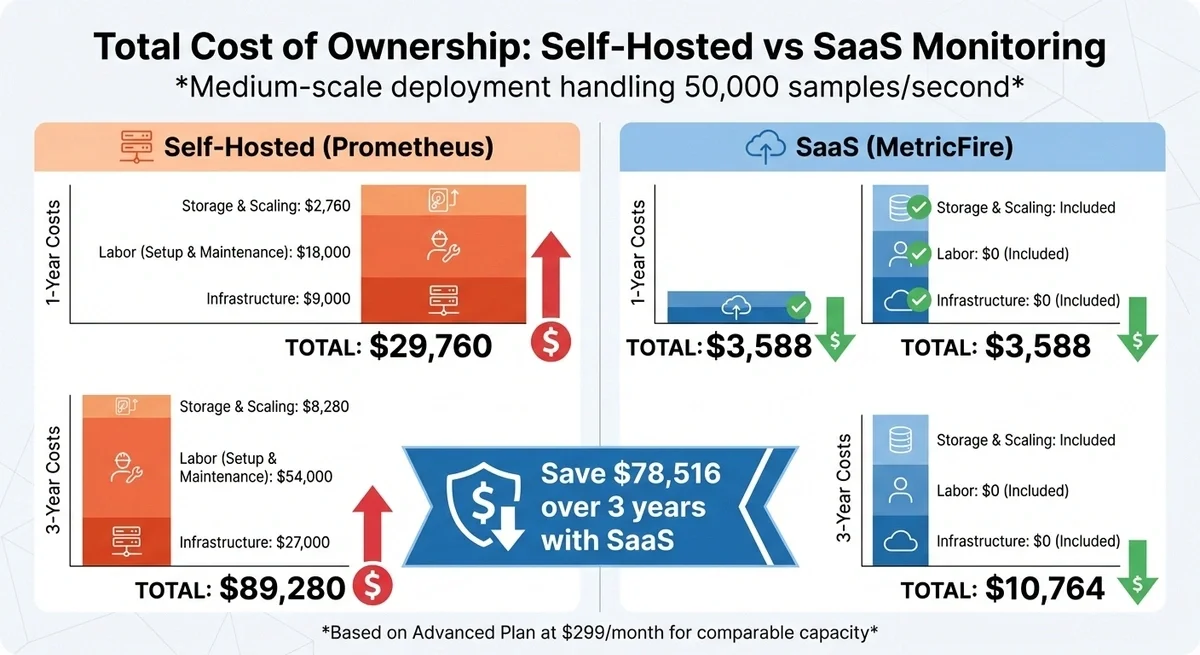
Self-Hosted vs SaaS Monitoring Costs: 3-Year Total Cost Comparison
When considering Total Cost of Ownership (TCO), it’s essential to factor in all expenses - initial hardware, setup, ongoing maintenance, and labor.
1-Year and 3-Year Cost Breakdown
Let’s break down the TCO for both self-hosted and SaaS solutions over one and three years to assess their financial performance.
For a self-hosted Prometheus setup handling 50,000 samples per second, the monthly costs include US $750 for three r5.large instances and storage (around US $23 per TB) and US $1,500 for labor. Add in storage and scaling costs at US $230 per month, and the annual expenses look like this:
- Infrastructure: US $9,000
- Labor: US $18,000
-
Storage & Scaling: US $2,760
Total: US $29,760 per year, or US $89,280 over three years.
On the other hand, MetricFire's SaaS solution offers an all-in-one subscription that simplifies expenses. For example, their Advanced Plan costs US $299 per month, which translates to US $3,588 annually or US $10,764 over three years. This pricing includes infrastructure, maintenance, and automatic scaling - eliminating additional labor and unexpected costs.
Here’s a side-by-side comparison for a medium-scale deployment:
| Cost Component | Self-Hosted (1 Year) | Self-Hosted (3 Years) | MetricFire SaaS (1 Year) | MetricFire SaaS (3 Years) |
|---|---|---|---|---|
| Infrastructure | US $9,000 | US $27,000 | US $0 | US $0 |
| Labor (Setup & Maintenance) | US $18,000 | US $54,000 | US $0 | US $0 |
| Storage & Scaling | US $2,760 | US $8,280 | Included | Included |
| Total | US $29,760 | US $89,280 | US $3,588 | US $10,764 |
Break-Even Analysis by Scale
The financial tipping point between self-hosted and SaaS solutions depends heavily on the size of your monitoring environment. For smaller setups - such as 300 hosts generating around 20,000 metrics - the cost difference may not be dramatic. In these cases, the simplicity and predictable pricing of SaaS still offer appeal, but the savings might not be as pronounced.
However, as your monitoring needs grow, the costs of self-hosting - particularly labor and scaling - can increase significantly. For larger environments, SaaS solutions like MetricFire’s shine, thanks to their automated scaling and consistent pricing. Vishal Biyani from Infracloud puts it succinctly:
"When the difference is more than 5-6K$ per month... you may as well recoup the cost of migration and maintenance as well within a year."
These insights emphasize how SaaS models become more cost-effective as your monitoring demands scale up, providing a clear edge in larger deployments.
Scalability and Hidden Expenses
As your infrastructure grows, the cost gap between self-hosted and SaaS monitoring solutions widens, and unexpected expenses can accumulate quickly.
Scaling Challenges for Self-Hosting
Expanding a self-hosted monitoring setup is no small task. It requires additional manual configuration and hardware provisioning, and the situation becomes even more complex with geographically distributed systems. Each location requires its own setup, complete with separate databases and additional storage for historical data. Then there’s the looming issue of cardinality explosion - when the number of unique time series spikes, your system can buckle under the pressure. This often forces immediate investments in hardware upgrades and storage expansion. As Satyadeep Ashwathnarayana from Netdata puts it:
"The cost of scaling your infrastructure may result in a substantial escalation in monitoring costs."
On top of that, labor costs climb. For enterprises managing 500+ servers, you might need a dedicated team - 1–2 full-time employees - just to oversee your monitoring infrastructure. It’s these layers of complexity that make the simplicity of SaaS solutions even more appealing.
Easy Scaling with SaaS
SaaS platforms remove the headaches of manual scaling. With MetricFire, for instance, scaling is as simple as upgrading your plan. There’s no need to provision servers, configure sharding, or troubleshoot distributed databases. The platform handles everything - capacity planning, load balancing, high-availability configurations, and storage growth - automatically.
This streamlined approach doesn’t just save effort; it also saves money. Take Codyas as an example: after switching to a managed monitoring solution, they reduced their monitoring staff costs by 67% and cut overall monitoring expenses by 46%. Similarly, the Falkland Islands Government saw a 30% reduction in cloud costs, driven by automated resource allocation and alerts.
Scalability Cost Comparison
Here’s a side-by-side look at how self-hosted scaling stacks up against SaaS scaling:
| Factor | Self-Hosted Scaling | SaaS Scaling with MetricFire |
|---|---|---|
| Manual Effort | High; requires sharding, federation, and load balancing | Zero; provider handles all scaling automatically |
| Capacity Planning | Manual forecasting and hardware procurement | Automated; built into the platform |
| Labor Requirements | Ongoing maintenance and scaling work | None - included in the subscription |
| Redundancy Setup | Manually build and test failover systems | Built-in high availability across clusters |
| Storage Management | Manual disk or S3 expansion as data grows | Managed storage is included in pricing |
| Cost Predictability | Variable (hardware, labor, and unexpected issues) | Fixed monthly subscription with clear tier pricing |
When you weigh these factors, the choice becomes evident. While self-hosted solutions might appear cheaper at first glance, the hidden costs - labor, complexity, and unforeseen expenses - can quickly escalate. Recognizing these challenges is key to making smart, long-term decisions for your budget.
Long-Term Budgeting Considerations
When it comes to long-term budgeting, the differences between self-hosted and SaaS monitoring solutions become even more pronounced. Building on the earlier cost breakdown and scalability analysis, this section explores how these expenses evolve over time.
Cost Growth in Self-Hosted Solutions
Self-hosted systems come with ongoing maintenance requirements like operating system updates, database optimization, and security patches. These tasks typically require an additional 10–20 DevOps hours per month, billed at approximately $100 per hour . As your infrastructure grows, so does its complexity - and the associated costs. For example, a startup managing 50 servers might spend between $15,000 and $25,000 in the first year on a self-hosted setup. For enterprises with over 500 servers, these costs can range from $150,000 to $300,000 annually.
Beyond direct expenses, risks such as downtime and delayed issue resolution can lead to significant financial losses. Poor visibility into monitoring in such scenarios can result in six-figure losses within minutes.
SaaS Cost Efficiency Over Time
SaaS solutions like MetricFire offer a different financial trajectory. These platforms handle maintenance, scaling, and availability, eliminating the need for manual updates or tuning. This allows your engineering team to focus on development priorities rather than operational overhead .
The cost comparison is striking. For a startup with 50 servers, SaaS costs range from $6,000 to $8,000 in the first year - far below the expense of a self-hosted solution. Enterprises with 500+ servers incur annual SaaS costs of $50,000–$150,000, roughly one-third to one-half of self-hosted expenses. Additionally, organizations using managed observability platforms have reported an average ROI of 165% and $7.75 million in benefits over three years. Some have even achieved a 60% reduction in observability data volumes while improving monitoring capabilities.
Matching SaaS Plans to Growth
MetricFire’s tiered pricing structure makes it easy to align costs with your organization’s growth.
- Pro Plan: At $19/month, this plan supports 10,000 metrics with six months of data retention, ideal for small teams.
- Advanced Plan: Priced at $299/month, it offers 20,000 metrics, 24 months of retention, and 24/7 support.
- Enterprise Plan: Designed for larger organizations, this plan includes dedicated clusters and tailored support.
Scaling with SaaS is straightforward - simply upgrade your plan. There’s no need to invest in additional hardware or handle manual scaling, which are unavoidable with self-hosted systems. For most organizations handling fewer than 100 million samples per day, the operational overhead of self-hosted setups rarely justifies their perceived cost savings .
Ultimately, SaaS solutions provide a smoother, more predictable path for scaling, making them a more practical choice for many businesses.
Conclusion: Choosing the Right Monitoring Model
Key Takeaways from the Comparison
Looking at the cost breakdown, it's clear that self-hosted monitoring can become more expensive over time. For example, startups managing 50 servers might spend between $15,000–$25,000 in their first year on self-hosted solutions. Compare that to $6,000–$8,000 for SaaS. For enterprises with over 500 servers, the annual costs could range from $150,000–$300,000 for self-hosted setups versus $50,000–$150,000 for SaaS options.
The difference largely comes down to hidden labor costs. Self-hosted solutions demand ongoing engineering resources for maintenance, security updates, and system optimization. On the other hand, SaaS solutions take care of these tasks for you, freeing up your team to focus on what matters most - your core business.
"The true cost of a monitoring solution extends far beyond the sticker price or subscription fees."
– Farouk Ben, Odown
Choose SaaS if you have limited technical resources, need a quick setup, or prefer predictable monthly expenses.
Opt for self-hosted only if you face strict regulatory requirements, need highly specialized customizations, or operate at a scale that justifies heavy infrastructure investment.
This breakdown highlights the financial and operational trade-offs, helping you determine which approach best aligns with your needs.
Final Recommendation
MetricFire stands out as a cost-effective and straightforward solution. Its Pro Plan, starting at $19/month, includes 10,000 metrics and 6 months of data retention. For larger needs, the Advanced Plan at $299/month supports 20,000 metrics and includes 24/7 customer support. Enterprise plans offer dedicated clusters and tailored support, eliminating the need for hardware procurement and manual scaling.
Built on open-source vs proprietary foundations, MetricFire ensures flexibility without vendor lock-in. It combines managed reliability with features like automated scaling and predictable pricing, making long-term budgeting easier. With rapid deployment and no hidden infrastructure costs, MetricFire provides a professional-grade monitoring solution that's both efficient and hassle-free.
FAQs
What are the hidden costs of using self-hosted monitoring solutions?
Self-hosted monitoring solutions might seem straightforward at first, but they often come with hidden costs that can take a toll on your budget. For starters, there are ongoing personnel expenses. Maintaining the system, addressing issues, and managing alerts require dedicated staff, and their salaries can quickly become a major expense.
On top of that, you’ll need to account for infrastructure costs. Scaling the system, ensuring adequate storage, and building custom integrations to fit your organization’s specific needs can add another layer of expense.
These costs don’t just stop after the initial setup - they accumulate over time. That’s why it’s crucial to take a hard look at the long-term financial and resource demands before committing to a self-hosted solution.
Why is SaaS monitoring more predictable in cost compared to self-hosted solutions?
SaaS monitoring simplifies budgeting with fixed subscription fees and clear pricing structures. Unlike self-hosted solutions that can come with surprise costs - like hardware upgrades, infrastructure expenses, or regular maintenance - SaaS eliminates these unpredictable financial hurdles.
Scaling is another area where SaaS stands out. Instead of pouring money into costly upfront investments, additional resources are seamlessly included in your subscription. This approach not only keeps costs manageable but also allows organizations to plan their monitoring expenses with greater confidence over the long term.
What should I consider when deciding between self-hosted and SaaS monitoring solutions?
When choosing between self-hosted and SaaS monitoring, there are a few important factors to weigh to find the right fit for your organization. One of the biggest considerations is cost. Self-hosted solutions often come with upfront expenses for hardware, setup, and ongoing maintenance. On the other hand, SaaS platforms usually follow a subscription-based pricing model, offering more predictable costs. That said, scaling and managing a self-hosted system can bring unexpected costs over time, so it’s important to account for those.
Scalability and maintenance play a big role too. SaaS platforms are typically easier to scale since they don’t require extra hardware or complicated configurations. In contrast, self-hosted systems demand regular attention to updates, security, and infrastructure, which can be resource-intensive.
Another key factor is control and customization. Self-hosted solutions allow for greater flexibility, letting you tailor the system to your specific needs - but this comes with the requirement for technical expertise. SaaS platforms, meanwhile, handle much of the behind-the-scenes work, making them a more hands-off option.
Lastly, think about your security and compliance requirements. Self-hosted systems give you full control over your data, which can be appealing for organizations with strict compliance needs. However, many SaaS providers invest heavily in security measures, offering strong protection for your data.
Ultimately, your choice should reflect your budget, available technical resources, and long-term goals for infrastructure monitoring.
Sign up for the free trial and begin monitoring your infrastructure today. You can also book a demo and talk to the MetricFire team directly about your monitoring needs.