


Table of Contents
- 5 Metrics to Track in IoT Firmware Monitoring
Great systems are not just built. They are monitored.
MetricFire is a managed observability platform that helps teams monitor production systems with clean dashboards and actionable alerts. Delivering signal, not noise. Without the operational burden of self-hosting.
5 Metrics to Track in IoT Firmware Monitoring
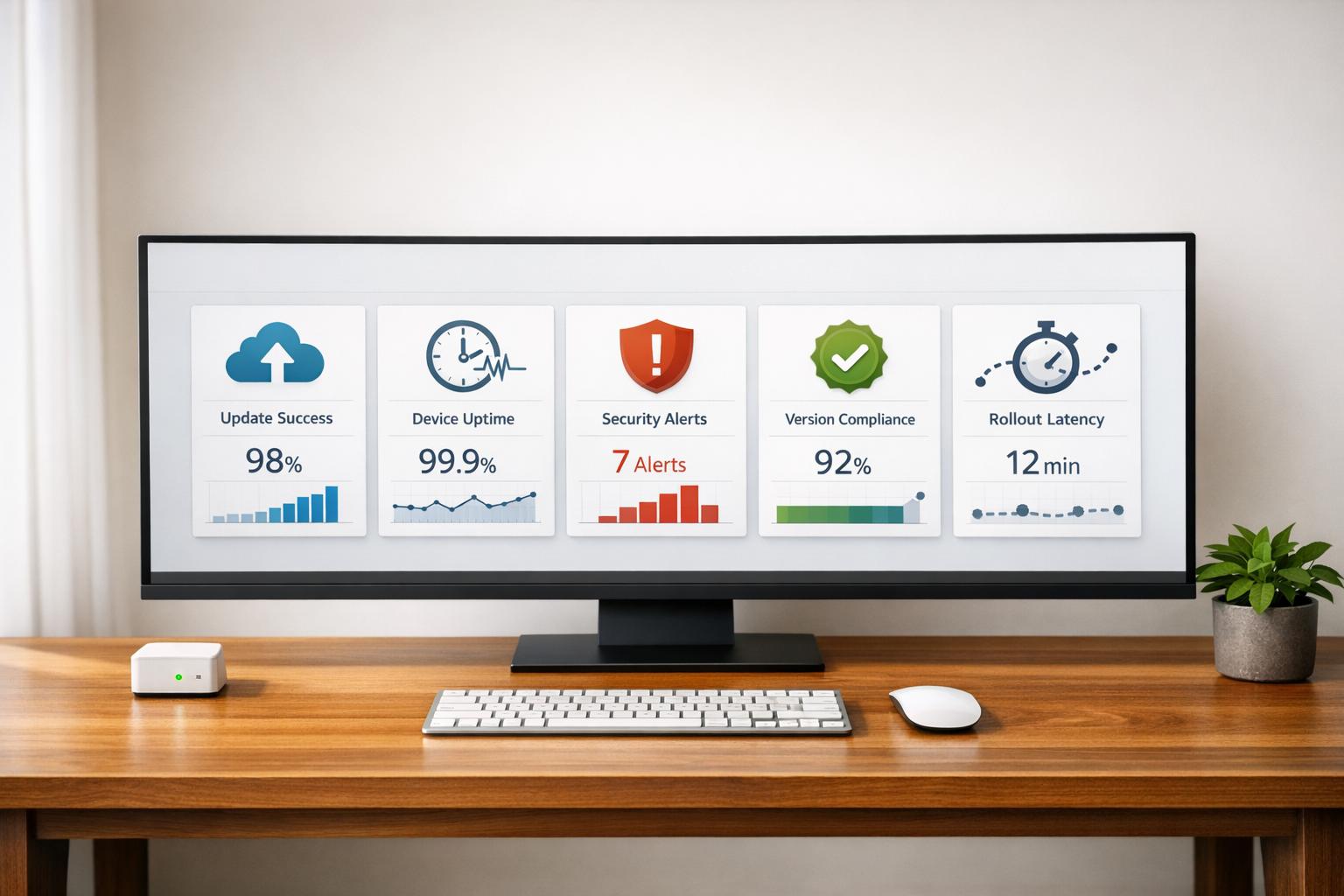
IoT devices rely on firmware to function seamlessly, but issues like crashes, unpatched vulnerabilities, or failed updates can lead to costly downtime. Using the best tools for monitoring IoT devices to track key metrics is critical to maintaining reliable, secure, and efficient operations. Here are the five metrics you need to focus on:
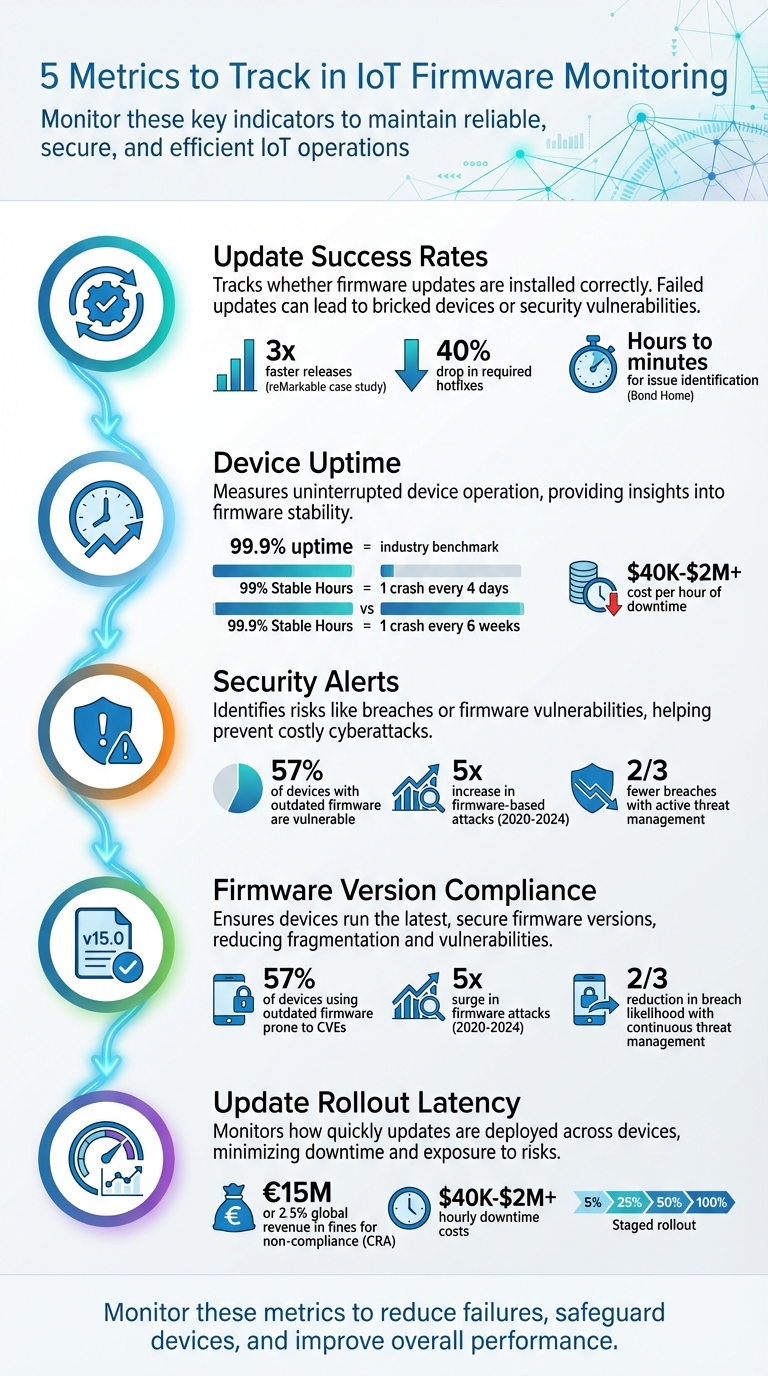
- Update Success Rates: Tracks whether firmware updates are installed correctly. Failed updates can lead to bricked devices or leave them vulnerable to security risks.
- Device Uptime: Measures uninterrupted device operation, providing insights into firmware stability. High uptime minimizes operational disruptions.
- Security Alerts: Identifies risks like breaches or firmware vulnerabilities, helping prevent costly cyberattacks or data loss.
- Firmware Version Compliance: Ensures devices are running the latest, secure firmware versions, reducing fragmentation and vulnerabilities.
- Update Rollout Latency: Monitors how quickly updates are deployed across devices, minimizing downtime and exposure to risks.
By monitoring these metrics, you can reduce failures, safeguard your devices, and improve overall performance.
[banner_cta title=“Sign up for a Demo!” text=“Get Hosted Graphite by MetricFire free for 14 days. No credit card required.“]
5 Essential Metrics for IoT Firmware Monitoring
1. Update Success Rates
Relevance to IoT Firmware Monitoring
Update success rates are a critical indicator that firmware updates are being delivered and installed correctly. They allow you to monitor telemetry data using MQTT and Graphite and take action - like halting or rolling back updates - when issues arise. Without this insight, you’re essentially operating in the dark, unable to determine whether devices are running the latest security patches or stuck on outdated, vulnerable software.
Failed updates can cause serious problems. Power outages, network disruptions, or even minor logic errors can result in bricked devices or disable Over-the-Air (OTA) functionality entirely, leaving devices stranded. These challenges directly impact the reliability of devices, as demonstrated in many real-world scenarios.
Impact on Device Reliability and Performance
When updates fail, the effects on device performance can be immediate and severe. Low success rates can disrupt operations and delay critical fixes. For example, in 2025, reMarkable, known for its paper-like tablets, adopted real-time update monitoring in its deployment process. This change led to three-times-faster releases and a 40% drop in required hotfixes. Similarly, Bond Home leveraged crash data during updates to reduce the time needed to identify and resolve firmware issues from hours to just minutes.
"A staged rollout with observability is often the only way to prevent a 1% failure from becoming a 100% catastrophe".
Implementing a phased rollout - starting with 5%, then increasing to 25%, 50%, and finally 100% of the fleet - helps minimize the "blast radius" if something goes wrong. Before deploying updates to production, running at least 100 successful OTA tests across a variety of hardware configurations is essential for identifying compatibility issues, such as those related to specific silicon versions or modem firmware.
Ability to Improve Security and Operational Efficiency
Update success rates are not just about reliability - they’re also key to maintaining security and operational efficiency. Since OTA updates are the main method for addressing vulnerabilities, monitoring success rates ensures that security patches are actually reaching your devices. In environments with diverse hardware configurations, these metrics highlight which device variants may struggle with new firmware, allowing you to address compatibility issues before deploying updates across the entire fleet.
Using a dual-bank (A/B) architecture can further safeguard operations by enabling automatic rollbacks in the event of a failed update. Post-update monitoring - tracking crash rates, reboot loops, and battery performance - helps confirm that updates are stable and functioning as intended.
"If OTA functionality isn't thoroughly tested before release, a failed update can have serious downstream consequences, including high RMA and field servicing costs".
2. Device Uptime
Relevance to IoT Firmware Monitoring
Device uptime measures how long a device operates without interruptions. It serves as a clear indicator of firmware stability and overall reliability. When unexpected downtime occurs, uptime data helps pinpoint whether the problem is due to firmware bugs, power issues, or network disruptions.
Modern IoT monitoring has evolved beyond just tracking uptime. Many teams now rely on metrics like "Stable Hours" (also called "Crash-Free Hours") to evaluate device reliability. This measures the percentage of hours a device operates without crashing. For instance, 99% Stable Hours means a crash occurs every 4 days, while 99.9% Stable Hours equates to one crash every 6 weeks. This metric provides a clear way to assess both operational and financial impacts.
Impact on Device Reliability and Performance
Device downtime can lead to steep financial losses. Depending on the industry, just one hour of downtime can cost anywhere from $40,000 in consumer goods to over $2 million in automotive manufacturing. This is why many IoT manufacturers aim for the elusive 99.9% uptime as their benchmark for reliability.
Real-world examples highlight how uptime directly relates to operational success. In May 2024, Bond Home introduced real-time crash and uptime monitoring into their firmware update process. According to Chris Merck, Vice President of Engineering, this innovation cut their firmware fix times from hours to mere minutes.
"Memfault gives us the hard data to be confident in the reliability of our firmware and proactively take action, resolving issues before our users are impacted."
- Raman Thapar, Director of Engineering, Latch
Ability to Improve Security and Operational Efficiency
Uptime monitoring not only supports update success rates but also ensures that stable firmware contributes to better security and efficiency. By tracking uptime, teams can compare the reliability of different firmware versions and quickly identify regressions after updates. This insight is crucial for making informed decisions about whether to proceed with firmware deployments. For always-on devices like Wi‑Fi or cellular-connected sensors, monitoring connectivity uptime - comparing actual connected time to expected connected time - helps distinguish between device failures and external factors like network issues.
"It's vital to Airthings that we act as swiftly as possible to provide uninterrupted, reliable service to our customers, and Memfault is a key tool for us in doing this."
- Audhild Randa, Chief Operating Officer, Airthings
3. Security Alerts
Relevance to IoT Firmware Monitoring
Security alerts are critical for identifying unauthorized access attempts, data breaches, and firmware vulnerabilities that can jeopardize an entire network's stability. They focus on spotting unusual behaviors, like unexpected traffic patterns or irregular reporting, which often indicate security issues before they escalate into full-blown failures. Firmware, often overlooked in security protocols, is especially at risk, making it a prime target for malicious actors. Alarmingly, 57% of devices running outdated firmware are vulnerable to numerous common exploits, and firmware-based attacks have surged fivefold over the past four years.
These alerts also play a key role in detecting malware hidden within firmware, which can evade traditional antivirus measures and prevent unauthorized device control. They flag performance anomalies such as CPU spikes or memory leaks, which are often telltale signs of compromised firmware or faulty updates. Critical issues like expired TLS certificates, which block devices from accessing update servers and lead to silent update failures, are also captured by these alerts. Beyond detecting breaches, security alerts work hand-in-hand with other monitoring tools to safeguard both device performance and security.
Impact on Device Reliability and Performance
By catching threats early, security alerts help maintain device reliability and reduce operational costs. Unsecured devices are more susceptible to cyberattacks, which can disrupt workflows and lead to data loss. Outdated firmware is another major risk, potentially destabilizing operations and causing compatibility issues. Research indicates that organizations actively managing threat exposures could experience two-thirds fewer breaches by 2026.
Real-time alerts for issues like watchdog triggers and boot loops provide early warnings of firmware instability, allowing teams to halt flawed rollouts before they affect the entire device fleet. Additionally, security alerts for unauthorized firmware updates or failed signature verifications ensure that devices maintain their integrity, preventing them from being permanently damaged by malicious code.
Ability to Improve Security and Operational Efficiency
Automated security alerts streamline the response to threats, minimizing human error when managing large device fleets. Real-time monitoring ensures teams can address problems before customers feel the impact, keeping devices operational and available. Behavioral monitoring - such as detecting sudden spikes in data usage or unusual connection patterns - can uncover early indicators of a breach. Alerts for failed root login attempts or unauthorized changes to network access points can identify cyberattacks in progress. Just like tracking update success rates or uptime, proactive security alerts are fundamental to preserving the integrity of IoT firmware and ensuring devices perform as expected.
"Without security-aware monitoring, IoT failures are detected too late - after impact occurs."
The Power of Metrics - Monitoring Battery Life, Connectivity, Power Consumption & More
4. Firmware Version Compliance
Tracking firmware version compliance is essential for maintaining consistency and security across your IoT device fleet.
Relevance to IoT Firmware Monitoring
Firmware version compliance involves monitoring which firmware versions are active across all devices. By tagging each device with details like its firmware version, SoC revision, and bootloader version, you can quickly determine which devices are ready for updates and which are running outdated systems. This is crucial for managing vulnerabilities: 57% of IoT devices using outdated firmware are prone to numerous common vulnerabilities and exposures (CVEs). Additionally, firmware-related attacks have surged more than fivefold between 2020 and 2024.
Effective compliance monitoring also prevents issues like "bricking" by ensuring updates are only sent to compatible devices and that older firmware versions follow the correct update paths. Dividing devices into cohorts - such as beta, production, and legacy - helps identify version-specific issues more efficiently. This approach allows teams to compare firmware releases side-by-side, spotting changes in battery life, memory usage, or connectivity performance.
Firmware version compliance, alongside metrics like update success rates, uptime, and security alerts, is a cornerstone of a secure IoT ecosystem.
Impact on Device Reliability and Performance
Maintaining firmware compliance reduces fragmentation, which often leads to hard-to-diagnose "ghost" bugs. When devices run different firmware versions, engineers may face challenges in linking crash reports or connectivity problems to specific builds. Centralizing version tracking simplifies updates and helps identify incompatibilities within device groups, cutting down on the need for urgent hotfixes.
Ability to Improve Security and Operational Efficiency
Automated tracking ensures devices receive timely security updates, minimizing vulnerabilities and malware risks. Implementing continuous threat management and using monotonic sequence numbers in firmware manifests can lower the likelihood of breaches by two-thirds and block malicious rollbacks.
For example, a home automation controller manufacturer integrated real-time crash analytics into their update process. This reduced the time needed to identify and fix firmware bugs from several hours to just minutes. Automated monitoring platforms also reduce human error, ensuring consistent compliance with security standards across large fleets. These improvements enhance both device reliability and operational efficiency.
5. Update Rollout Latency
Relevance to IoT Firmware Monitoring
Alongside metrics like update success rates and device uptime, rollout latency plays a key role in monitoring IoT firmware performance. This metric tracks how long it takes to deploy and successfully install firmware updates across your entire device fleet. It’s a vital part of maintaining a "closed-loop" system where you deploy, monitor, and address any issues that arise. Monitoring rollout speed can also reveal subtle problems, such as memory fragmentation or CPU overload.
Delays in rollout latency create a window of risk. With the growing number of IoT devices, every minute of delay leaves more devices vulnerable to security breaches or firmware bugs. Beyond security concerns, high latency can also lead to operational inefficiencies. For instance, downtime costs can range from $40,000 per hour in sectors like consumer goods to over $2 million in automotive manufacturing. Adding to the urgency, the Cyber Resilience Act (CRA), effective December 2024, requires timely updates. Failing to comply could result in fines of up to €15 million or 2.5% of global revenue.
Impact on Device Reliability and Performance
Unmanaged rollout latency can trigger issues like the "Thundering Herd" problem, where thousands of devices simultaneously request updates, overwhelming backend systems. This can lead to failed deployments and leave devices in inconsistent states. To address this, a staged rollout approach - starting with just 5% of devices - can help avoid server overload and ensure updates are deployed smoothly across the fleet.
Ability to Improve Security and Operational Efficiency
Minimizing rollout latency is essential for ensuring updates are both timely and secure, which strengthens the overall reliability of your IoT ecosystem. Achieving this involves implementing smart strategies. For example, delta updates, which send only the binary differences between the existing and new firmware, can drastically reduce data transfer times and speed up installations. Staggered rollouts with randomized polling intervals, such as hourly checks, can also prevent backend bottlenecks while maintaining steady progress.
Pre-update health checks are another critical measure, ensuring devices have sufficient battery levels and memory before updates begin. Additionally, automating certificate rotation using protocols like EST or ACME can prevent over-the-air (OTA) failures caused by expired TLS certificates, ensuring updates proceed without interruptions. These approaches not only enhance security but also free up engineering teams to focus on other priorities.
Ready to streamline your update rollout process? Sign up for a free trial or schedule a demo with MetricFire today.
How MetricFire Supports IoT Firmware Monitoring

MetricFire combines Graphite's powerful metric collection with Grafana's intuitive visualization to keep an eye on IoT firmware performance. It tracks essential metrics like update rates, uptime, security, compliance, and rollout latency - key indicators of firmware health. The platform is fully managed, making it easy to collect, store, and visualize data across your entire IoT device network.
With MetricFire, raw data becomes actionable insights. Customizable Grafana dashboards let you view all five critical firmware metrics in one place. These dashboards can pull real-time data from thousands of devices, helping you spot trends like outdated firmware versions or regions with delayed updates. Whether you’re monitoring a small test deployment or a large-scale IoT network, you can tailor the dashboards to meet your team's unique needs.
MetricFire also offers responsive alerting to catch problems before they grow. Alerts can be set up for issues like repeated failed updates, unexpected device downtime, or detected security vulnerabilities. Notifications integrate seamlessly with tools like PagerDuty, Slack, email, or webhooks, ensuring your team is informed through the channels they already use. This minimizes unnecessary noise while prioritizing urgent firmware issues.
The platform simplifies IoT data collection by supporting a wide range of IoT protocols and formats, eliminating the need to build custom pipelines. You can start monitoring key metrics like firmware compliance and update rollout times right away. MetricFire's Graphite backend efficiently handles time-series data while maintaining open-source compatibility.
Conclusion
Keeping an eye on these five metrics ensures full visibility into your fleet's performance. Together, they help detect crashes early, protect vulnerable devices, and roll out patches effectively. Considering downtime can cost $40,000 per hour in consumer goods and over $2 million in automotive manufacturing, staying proactive is not just smart - it’s necessary.
"Monitoring IoT devices is critical for company management... if you are not monitoring those IoT devices, you are not maximizing your value and risk having an IoT failure put your company to a halt." – MetricFire
By refining your monitoring approach, you safeguard your IoT devices while streamlining operations. Proactive management isn’t just an option - it’s a must.
MetricFire simplifies this process by turning metrics into actionable insights. Their platform integrates data collection, visualization, and automated alerts, ensuring your IoT network is protected. With tools like long-term data retention for trend analysis, customizable dashboards for fleet-wide monitoring, and instant alerts through your preferred channels, MetricFire lets you focus on improving firmware and security instead of building monitoring systems from scratch.
Ready to take the next step? Sign up for a free trial (https://www.hostedgraphite.com/accounts/signup/) to start monitoring your infrastructure today. Or, book a demo (https://www.metricfire.com/demo/) to chat with the MetricFire team about your specific needs.
FAQs
What are realistic targets for firmware update success rates?
Setting realistic targets for firmware update success rates is crucial, with most experts suggesting aiming for rates above 90%. In fact, many industry standards recommend pushing for at least 95%. This level helps ensure reliable over-the-air (OTA) updates while minimizing risks like device bricking. Hitting these benchmarks is essential for maintaining system stability and keeping user trust intact.
How do I measure “crash-free” uptime across my device fleet?
To evaluate "crash-free" uptime, focus on tracking the total hours your devices operate without experiencing crashes or failures. This involves using metrics like "Crash Free Hours", which are usually gathered through on-device SDKs. These SDKs log both the operational hours and any crash events. By comparing the number of crash-free hours to the total operational hours, you can gauge device reliability, spot recurring patterns, and tackle issues that may be impacting uptime.
How can I reduce update rollout latency without overloading servers?
To reduce update rollout delays and prevent overloading servers, consider using staged or controlled rollouts. This approach limits the number of devices receiving updates simultaneously, lowering risks and providing an opportunity to monitor performance during deployment. Using a cloud-based update orchestrator can further simplify the process, ensuring updates are delivered efficiently without putting excessive strain on your infrastructure.